

Why In-Ear Monitors Are More Than Just "Sound Restoration"
Core Thesis: In-ear monitors (IEMs) must deliver precise sound reproduction, but high-fidelity reproduction is merely the prerequisite. Their true purpose is to establish reliable acoustic feedback—transforming vocal control, instrumental performance, tracking, and mixing decisions into actionable data so creators can confidently determine their next operational adjustment.
In short: Reproduction renders feedback trustworthy; feedback gives reproduction its utility in practical workflows.
*Note: "Feedback" in this engineering context refers to the closed-loop workflow cycle of "Action → Acoustic Result → Subsequent Adjustment," rather than electroacoustic feedback (howling/screeching) caused by gain-before-feedback limits in sound reinforcement systems.
Why Is Focusing Solely on "Reproduction" Insufficient?
In actual creative workflows, monitoring systems rarely evaluate an abstract "pure source." Instead, they operate on a complex signal chain modified by microphones, room acoustics, preamps, AD/DA conversion, editing, and signal processing.
Engineers and performers need to make definitive evaluation judgments:
- Whether vocal pitch, breath management, and sibilance are within acceptable thresholds;
- Whether instrumental attack speed, dynamic control, and rhythmic alignment are precise;
- How spectral balance shifts as mic positioning and proximity effect change;
- Whether EQ, dynamic compression, and time-based effects resolve acoustic issues or introduce new artifacts;
- Whether audio processed on the monitoring system translates accurately across consumer playback environments.
If a monitor masks sibilance, transient detail, distortion, or macro/micro-dynamics, creators will continue processing based on false information. Conversely, if a monitor artificially boosts specific frequency bands to create artificial excitement, it can trick engineers into applying excessive corrective EQ or over-compression.
Therefore, a superior monitor is not designed to make all audio sound pleasing; it is engineered to make acoustic shifts instantly perceptible, ensuring decision-making is backed by accurate data.
What Exactly Does an In-Ear Monitor Provide Feedback On?
Essential Conditions for Effective Acoustic Feedback
A reliable monitoring system cannot be judged solely by a static frequency response curve. It demands the concurrent realization of several electroacoustic capabilities:
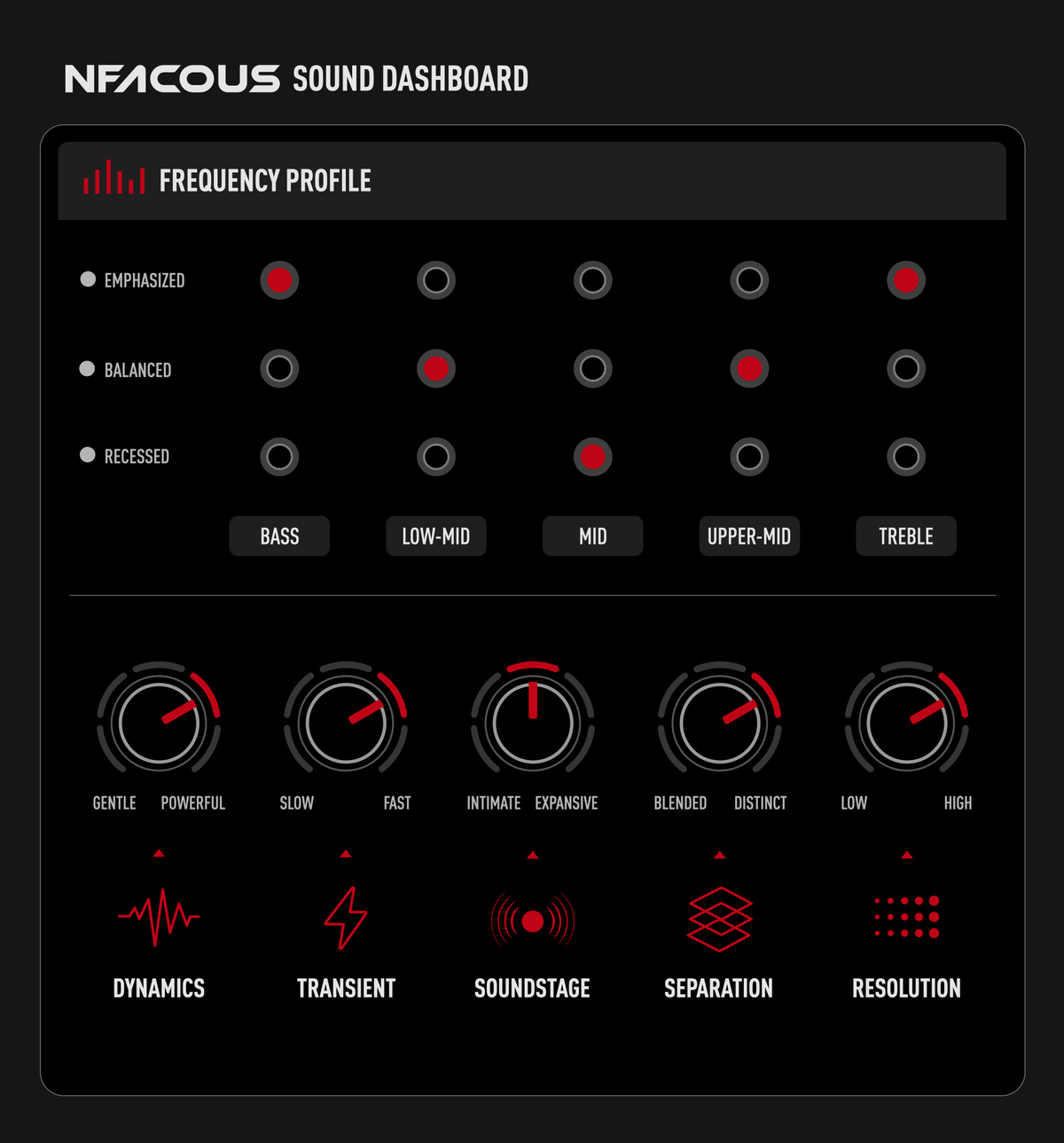
- Balanced Frequency Relationship: Facilitates accurate assessment of vocal timbre, instrument balance, and overall spectral energy without unnatural frequency tilts that induce corrective mixing errors.
- Sufficient Acoustic Resolution & Detail Retrieval: Enables immediate detection of noise, harsh sibilance, non-linear distortion, splice/edit clicks, and decay tails of time-based effects.
- Precise Transient Response & Dynamic Headroom: Preserves initial attack velocity, punch, and subtle macro/micro-dynamic variations resulting from compressor knee/attack/release adjustments.
- Consistent Physical Fit & Acoustic Isolation: Crucial for stage and mobile workflows; changes in acoustic seal directly compromise low-frequency extension and overall tonal balance.
- Workflow-Tailored Operational Reliability: Ergonomics, cable termination, and long-term wearing comfort directly affect an engineer's or performer's ability to maintain objective judgment over extended sessions.
Hence, asking "Is a flatter frequency response always better for a monitor?" is an incomplete question. The crucial question is: "Does this monitor consistently deliver discernible, comparable, and actionable acoustic data within your specific operational environment?"
Different Products Target Distinct Operational Tasks
There is no single "universal form factor" for monitoring headphones. In-ear monitors (IEMs), closed-back studio headphones, and audiophile music earphones are designed around different acoustic environments and priority hierarchies.
| Model | Product Positioning & Form Factor | Target Operational Use Case |
|---|---|---|
| NM20 | Professional Series Dynamic In-Ear Monitor | Stage monitoring, vocal/instrumental performance, live streaming, tracking, video editing, and foundational mixing assessment. Focused on fast transient response, high resolution, and ample dynamic headroom to expose performance and processing nuances. |
| NH20 | Closed-Back Studio Headphones (Music Production) | Tailored for users who prefer a closed-back over-ear form factor, primarily operating in studio recording, tracking, and desktop music production environments. |
| NA20 | Music Series Dynamic In-Ear Headphones | Prioritizes immersive musicality, smooth fatigue-free listening, and emotional engagement. Designed for music enjoyment rather than analytical tracking or processing verification. |
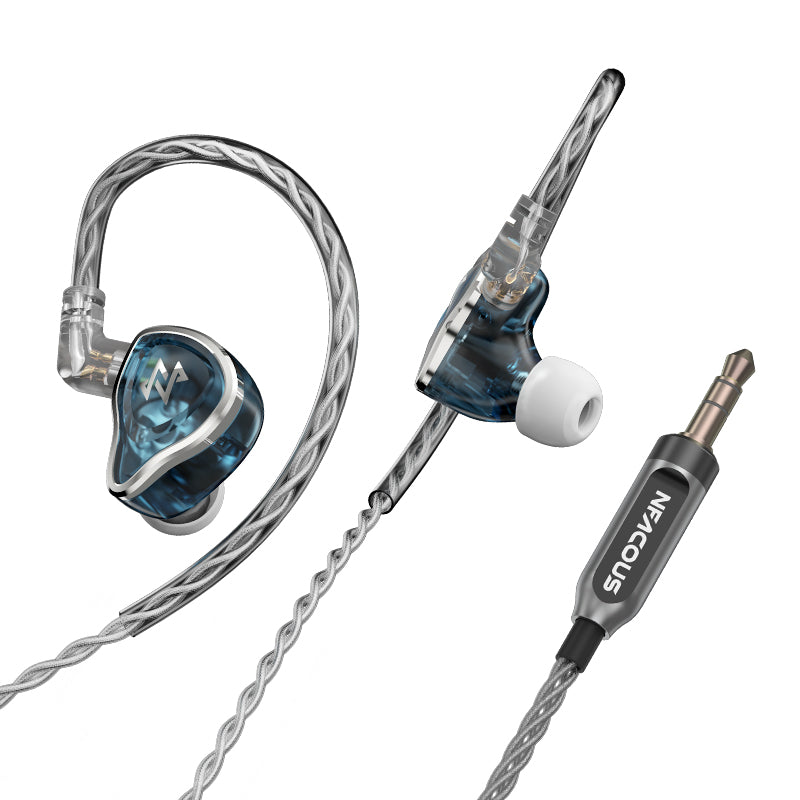
Taking the NM20 as an example: its purpose is not to "interpret" or embellish sound on behalf of the creator, but to unmask and return the raw differences caused by physical performance and signal processing back to the creator. Its MC2L-100P dynamic driver unit, acoustic damping system, and precision shell cavity control work in unison to deliver fast, clear, and high-headroom professional feedback.
This demonstrates that monitoring gear and audiophile gear do not exist on a simple "superior vs. inferior" hierarchy—they serve fundamentally different tasks. One prioritizes unmasking flaws and operational changes, while the other emphasizes timbre smoothness, spatial immersion, and long-term listening pleasure. They should not be evaluated under a single, rigid standard.
Can In-Ear Monitors Replace Studio Monitors for Final Mixing & Mastering?
Not entirely.
While earphones eliminate room acoustic modes and facilitate microscopic detail inspection, the perception of soundstage width, phantom center imaging, crossfeed, and visceral low-frequency energy in IEMs differs from physical midfield/farfield monitor speakers; furthermore, IEM performance is influenced by eartip acoustic sealing, insertion depth, and individual ear canal geometry.
Therefore, as workflows move toward critical mixing and final mastering, cross-verification using calibrated studio monitor speakers, reference tracks, and varied playback systems becomes essential. The NM20 excels in tracking, editing, and foundational mixing evaluation, but it should not be positioned as the sole isolated reference for full mastering decisions.
Three Questions to Ask Before Selecting a Monitor
- What acoustic variables do you need to audit? Is it pitch, transient attack, and dynamic execution? Or noise floor, EQ moves, compression artifacts, and reverb tails?
- In what environment will you operate? Stage performance, rehearsal spaces, live broadcast booths, mobile field recording, and treated control rooms have vastly different demands for isolation, ergonomics, and form factor.
- What stage of decision-making are you performing? Real-time performance cues, tracking error checks, rough mixing/editing, and final mastering require different toolsets and verification methods.
Defining the specific task first before choosing gear is far more reliable than chasing isolated technical specifications.
Frequently Asked Questions (FAQ)
1. Does "In-Ear Monitor" mean an "absolutely flat" frequency response curve?
No. Frequency balance is critical, but transient fidelity, dynamic range, non-linear distortion, phase consistency, channel matching, physical seal, and long-term stability equally dictate monitoring efficacy. A frequency response curve alone cannot fully define a monitor's practical performance.
2. Are monitoring headphones supposed to sound harsh or unpleasing?
No. The goal of a monitor is to minimize masking and misdirection, not to artificially induce harshness or graininess. "Revealing acoustic flaws" and "sounding inherently unpleasant" are entirely different concepts.
3. Can in-ear monitors be used for general music listening?
Yes, though suitability depends on personal acoustic preferences. Monitors are tuned for analytical clarity and error detection; if your main goal is smooth, musical immersion and fatigue-free enjoyment, products in the Music Series (such as the NA20) offer a more direct solution.
4. Can the NM20 be used for audio mixing?
Yes. The NM20 is well-suited for foundational mixing decisions, detail checking, and auditing processing moves. However, for critical final mixing and mastering, relying solely on any single headphone model is not recommended; multi-system cross-verification is always advised.
5. Which is more professional: In-Ear Monitors (IEMs) or Over-Ear Studio Headphones?
Professionalism is determined by application fit, not form factor alone. IEMs offer superior portability, noise isolation, and stability for stage and mobile environments; closed-back over-ear headphones align well with traditional studio tracking and indoor production workflows. Selection should be based on task, environment, and verification requirements.

Leave a comment
This site is protected by hCaptcha and the hCaptcha Privacy Policy and Terms of Service apply.